 Contact Us

 Home
Home→ Learn more about AI ERP (https://ai-erp.itecerp.com)
Breaking News
AI Is Redefining ERP, Driving Businesses Toward Smarter Decision-Making TaiMao Technology Joins 48 Enterprises to Explore the Future of AI-Powered ERP
Generative AI is advancing rapidly, and enterprise digital transformation is entering a new stage. In the past, the key concern for enterprises was "whether to adopt AI." Now the more critical question has become: "How can AI truly integrate with a company's existing data, processes, and core systems?"
iTECERP Technology held the "AI Enterprise Digital Transformation Forum" on September 9, an invitation-only event that drew participation from 48 companies. On-site exchanges showed that enterprises' expectations for AI are rapidly shifting from single-point tool applications toward deep integration with ERP, enterprise data, and actual operational processes.
This also reflects an important turning point in enterprise AI development: AI's next battleground is not just content generation, but entering the core operations of the enterprise.
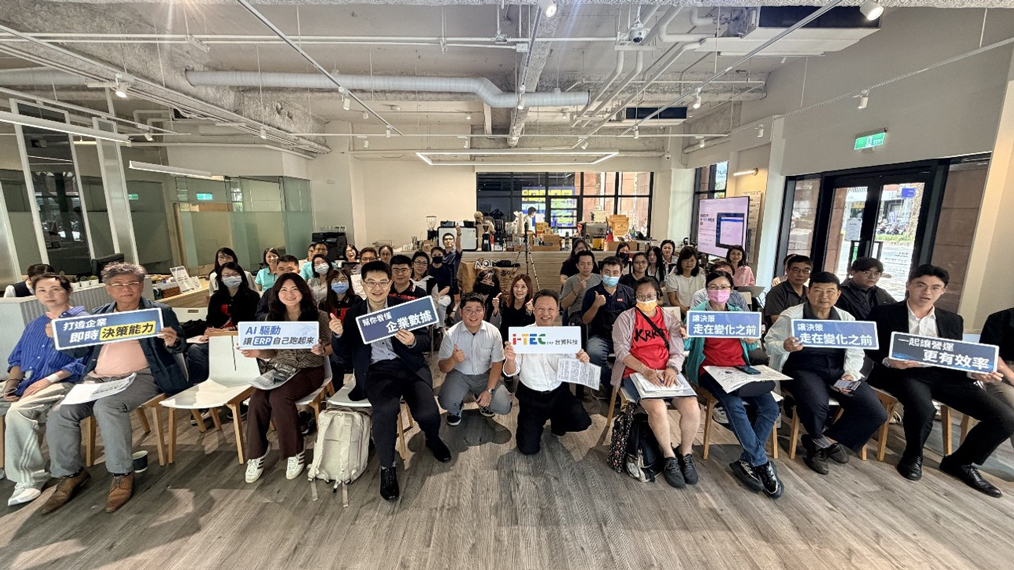
As AI Enters the Enterprise, ERP Becomes a Critical Data Foundation
For most enterprises, the data with real operational value has long accumulated within ERP. From customer orders, procurement, inventory, and manufacturing, to accounts receivable and payable, cost, and financial information, ERP records the operational activities that actually take place in a company every day. Therefore, as AI moves from personal productivity tools into enterprise decision-making scenarios, how to enable AI to understand and use a company's trustworthy data will become an important issue in the next stage of digital transformation.
We believe that AI will not replace ERP, but will redefine the value of ERP.
The core task of traditional ERP is to help enterprises establish standard processes and keep accurate records; ERP in the AI era will further move from "recording what has happened" to "understanding what is happening," and even help managers detect anomalies and risks earlier.
For example: whether inventory is about to run low, whether orders may be delayed, whether costs are showing anomalies, which products or orders have declining gross margins, and which operational indicators currently require a manager's immediate attention.
The answers to these questions cannot be produced by a large language model alone; they must be built on a foundation of accurate enterprise data and processes.
From System of Record to System of Intelligence
Facing the transformation of enterprise information architecture brought about by AI, i-TEC continues to advance ERP from the traditional System of Record toward a smart operations platform with analysis, early-warning, and decision-support capabilities.
What enterprises need in the future is not just more AI tools, but an architecture in which ERP + AI helps a company's internal and external systems connect with one another.
i-TEC continues to develop applications such as AI ERP, process automation, and data command centers, aiming to reconnect enterprise data that was previously scattered across different processes and further transform it into management information and a basis for decision-making.
This also represents a shift in the role of ERP. In the past, ERP mainly served "operational processes"; in the future, in addition to supporting daily operations, ERP will gradually become an important data foundation for AI to understand the enterprise.
For Enterprise AI Adoption, the Key Is Not Chasing Models, but Finding Operational Scenarios
The forum also focused on practical enterprise AI applications. i-TEC Senior Consultant Chang Yu-cheng drew on everyday enterprise operations and management scenarios to share how AI can be applied to data organization, information retrieval, process optimization, and decision support; Systex Corporation was also invited to attend, drawing on real enterprise implementation experience to explain how AI is put into practice in daily work and operational scenarios.
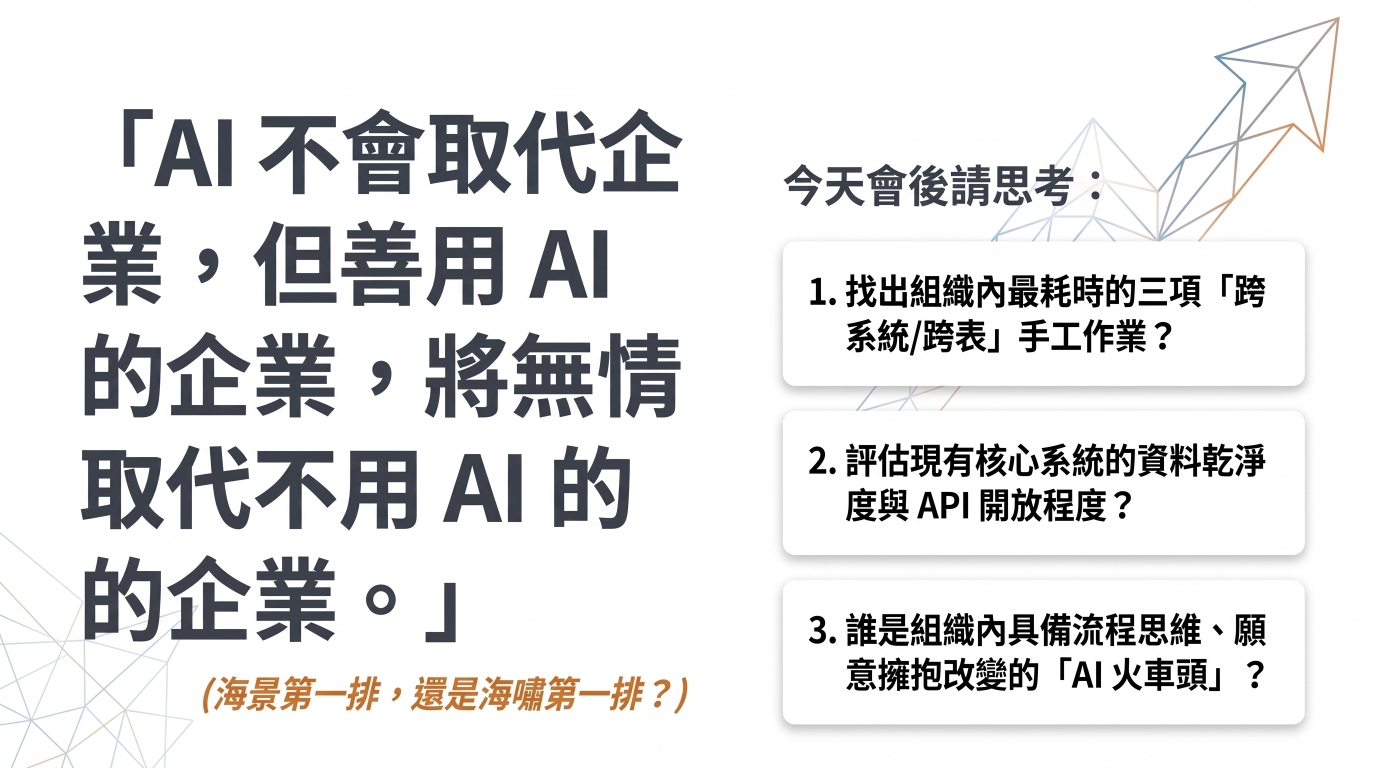
Discussions at the forum also showed that enterprises' attitudes toward AI are becoming increasingly pragmatic. Rather than simply comparing model capabilities or chasing the latest AI tools, what enterprises care more about is: "Can this technology actually solve my problem?"
Therefore, the starting point for AI adoption should not be choosing a model, but returning to the enterprise's own operational issues — starting by taking stock of where the data is, how processes work, which tasks rely heavily on human judgment, and which risks managers always notice too late.
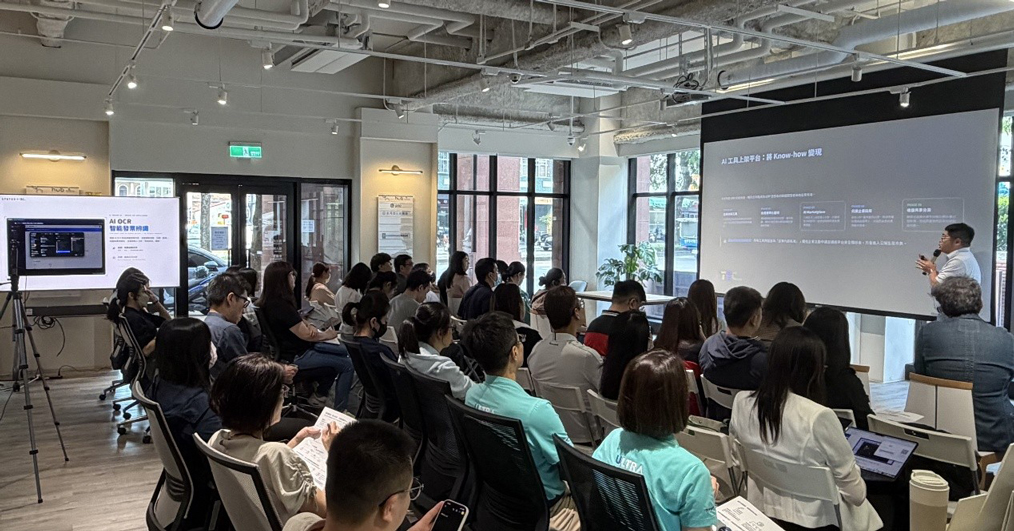
AI Adoption Is Moving from a Technology Issue to an Enterprise Transformation Project
As AI applications deepen, what enterprises face is no longer simply a matter of IT technology selection. Data governance, process standardization, system integration, talent capability, and investment return will all affect whether AI can truly be put into practice.
i-TEC points out that enterprises do not need to complete an entire transformation at once when adopting AI; instead, they should start from the operational scenarios with the greatest value and gradually let data, systems, and AI form new enterprise capabilities.
i-TEC: The Next Generation of ERP Should Not Just Record the Enterprise, but Help It See the Future
Having been deeply engaged in ERP and enterprise informatization for more than 30 years, i-TEC has observed that AI is driving a new round of role transformation in the ERP industry.
In the past, ERP solved the problem of "how enterprises do things correctly"; in the AI era, enterprises now expect the system to further answer: "What problem is happening right now?" "What might happen next?" "What should managers pay attention to right now?"
This is also the core direction of i-TEC's development of AI ERP.
Going forward, i-TEC will continue to use ERP as the enterprise's trustworthy data core, combining it with AI, Agent-based intent automation, and other process integrations, so that enterprise operations become automated and visualized in a command center — allowing operational data such as orders, procurement, inventory, production, finance, and cost to no longer be merely stored and queried, but gradually transformed into a capability for enterprise analysis, early warning, and decision-making.
As AI begins to enter core enterprise operations, ERP's next competitive edge will not simply be recording data more completely, but whether it can help enterprises spot problems earlier and make decisions faster.
This will also remain an important direction for i-TEC's continued development of AI ERP.
About i-TEC
iTECERP Technology Co., Ltd. (i-TEC) has been deeply engaged in ERP and enterprise informatization services for more than 30 years, long assisting enterprises in integrating orders, procurement, inventory, production, finance, cost, and operational management processes.
Facing the AI era, i-TEC continues to advance ERP from an enterprise System of Record toward a smart operations platform with analysis, early-warning, and decision-support capabilities, and is developing applications such as AI ERP, API integration, process automation, and data command centers, helping enterprises build a trustworthy data foundation so that AI can truly enter enterprise processes and operational decision-making.


Related Information

PDMS+ERP Online Technical Seminar Held Grandly!
Industry-University Cooperation and Skilled Personnel Trainning with NCUT
iTEC ERP Product Introduction Video
ERP Knowledge Base
How to rapidly consolidate the financial accounts of multiple companies within a group?The issues of non-real-time updates and frequent rework have caused significant challenges for finance and accounting personnel. The iTEC ERP real-time financial integration framework effectively addresses the drawbacks of traditional ERP operation models....
How to manage frequent engineering changes (ECO/ECR/ECN) effectively?Due to the rapid changes in both internal and external environments, frequent engineering changes have become inevitable. How to utilize the i-TEC ERP intelligent change platform to swiftly respond to change requirements? To enhance...
ERP operational model in different industry?Different industries have different operational models, how do you choose a suitable ERP system? Taking the bicycle industry as an example, explain the application of i-TEC ERP in the operational model...